Amendment to Duties To Address the Flow of Illicit Drugs Across Our Northern Border
Signed: July 31, 2025
Published: August 6, 2025
Document Number: 2025-14999
📋Summary
This executive order raises the extra U.S. import tariff on certain Canadian goods covered by the earlier order from 25% to 35%, citing Canada’s insufficient action to stop fentanyl and other illicit drugs and Canada’s retaliation against prior U.S. measures. It affects importers and buyers of covered Canadian products, as well as U.S. agencies that administer tariffs and border enforcement; goods that qualify for duty-free treatment under the USMCA remain exempt as under the prior amendment. The higher 35% rate applies to covered goods entered for U.S. consumption on or after 12:01 a.m. EDT on August 1, 2025, and the tariff schedule is updated to reflect the change, with existing “tariff stacking” rules still applying. It also targets duty evasion by imposing a 40% additional tariff (plus other penalties) on non-USMCA-qualifying Canadian goods that CBP finds were transshipped to dodge the duties, and directs Commerce and DHS/CBP to publish a twice-yearly list of countries and facilities involved in circumvention schemes. DHS is directed to keep monitoring the situation and advise the President on whether more action is needed or whether Canada has taken adequate steps, and DHS is authorized (with other agencies) to issue implementing rules and make technical tariff updates.
💼Business Impact
This order raises the extra tariff on **non‑USMCA‑originating Canadian goods from 25% to 35% effective Aug. 1, 2025**, with a **40% rate plus penalties** for goods CBP finds were **transshipped to evade duties**—so the most affected businesses are **importers, manufacturers, and distributors** sourcing Canadian inputs that **don’t qualify under USMCA** (notably **industrial materials/components and non‑USMCA‑compliant finished goods**), while **energy/energy resources and potash** remain under the prior special rates. Compliance risk increases for any firm using **multi-country supply chains** (Canada + third-country processing) because CBP will scrutinize **origin claims and routing**, and Commerce/CBP will publish **facility/country circumvention lists** that can affect procurement and due diligence. Immediate actions: **map all Canada-linked SKUs to HTS codes and USMCA origin status**, re-price landed costs for the 35% duty (and any stacking tariffs), tighten **supplier certifications/traceability (BOMs, origin affidavits, shipping docs)** to avoid transshipment findings, and consider **re
Full Text
Executive Order 14325 of July 31, 2025
Amendment to Duties To Address the Flow of Illicit Drugs Across Our Northern Border
By the authority vested in me as President by the Constitution and the laws of the United States of America, including the International Emergency Economic Powers Act (50 U.S.C. 1701 et seq.) (IEEPA), the National Emergencies Act (50 U.S.C. 1601 et seq.), section 604 of the Trade Act of 1974, as amended (19 U.S.C. 2483), and section 301 of title 3, United States Code, I hereby determine and order:
Section 1 . Background. In Executive Order 14193 of February 1, 2025 (Imposing Duties To Address the Flow of Illicit Drugs Across Our Northern Border), I declared a national emergency arising from certain conditions, including the public health crisis caused by fentanyl and other illicit drugs, and the failure of Canada to do more to arrest, seize, detain, or otherwise intercept drug trafficking organizations, other drug or human traffickers, criminals at large, and illicit drugs. In that order, I found that those conditions constitute an unusual and extraordinary threat, which has its source in substantial part outside the United States, to the national security, foreign policy, and economy of the United States.
To deal with the emergency declared in Executive Order 14193, I imposed an additional ad valorem rate of duty of 25 percent on certain articles that are products of Canada and an additional ad valorem rate of duty of 10 percent on certain energy or energy resources that are products of Canada. In Executive Order 14231 of March 6, 2025 (Amendment to Duties To Address the Flow of Illicit Drugs Across Our Northern Border), I provided that the additional ad valorem rates of duties under Executive Order 14193 do not apply to articles that are products of Canada that qualify for duty-free entry under the Agreement between the United States of America, United Mexican States, and Canada (USMCA), and I reduced the additional ad valorem rate of duty on potash from 25 percent to 10 percent.
Section 2(d) of Executive Order 14193 provides that “[s]hould Canada retaliate against the United States . . . through import duties on United States exports to Canada or similar measures,” I “may increase or expand in scope the duties imposed . . . to ensure the efficacy of th[e] action” taken in Executive Order 14193. Section 3(b) of Executive Order 14193 provides that the Secretary of Homeland Security, in coordination with other senior officials, “shall recommend additional action, if necessary, should the Government of Canada fail to take adequate steps to alleviate the illegal migration and illicit drug crises through cooperative enforcement actions.”
I have received additional information and recommendations from various senior officials regarding, among other things, Canada's lack of cooperation in stemming the flood of fentanyl and other illicit drugs across our northern border—including its failure to devote satisfactory resources to arrest, seize, detain, or otherwise intercept drug trafficking organizations, other drug or human traffickers, criminals at large, and illicit drugs—and Canada's efforts to retaliate against the United States in response to Executive Order 14193, as amended. After considering the additional information and recommendations that I have received, among other things, I have determined that, for the products of Canada that are subject to the additional ad valorem rate of duty of 25 percent, the additional ad valorem rate of duty shall increase from 25 percent to 35 percent. In my judgment, this action is ( printed page 37958) necessary and appropriate to deal with the emergency declared in Executive Order 14193.
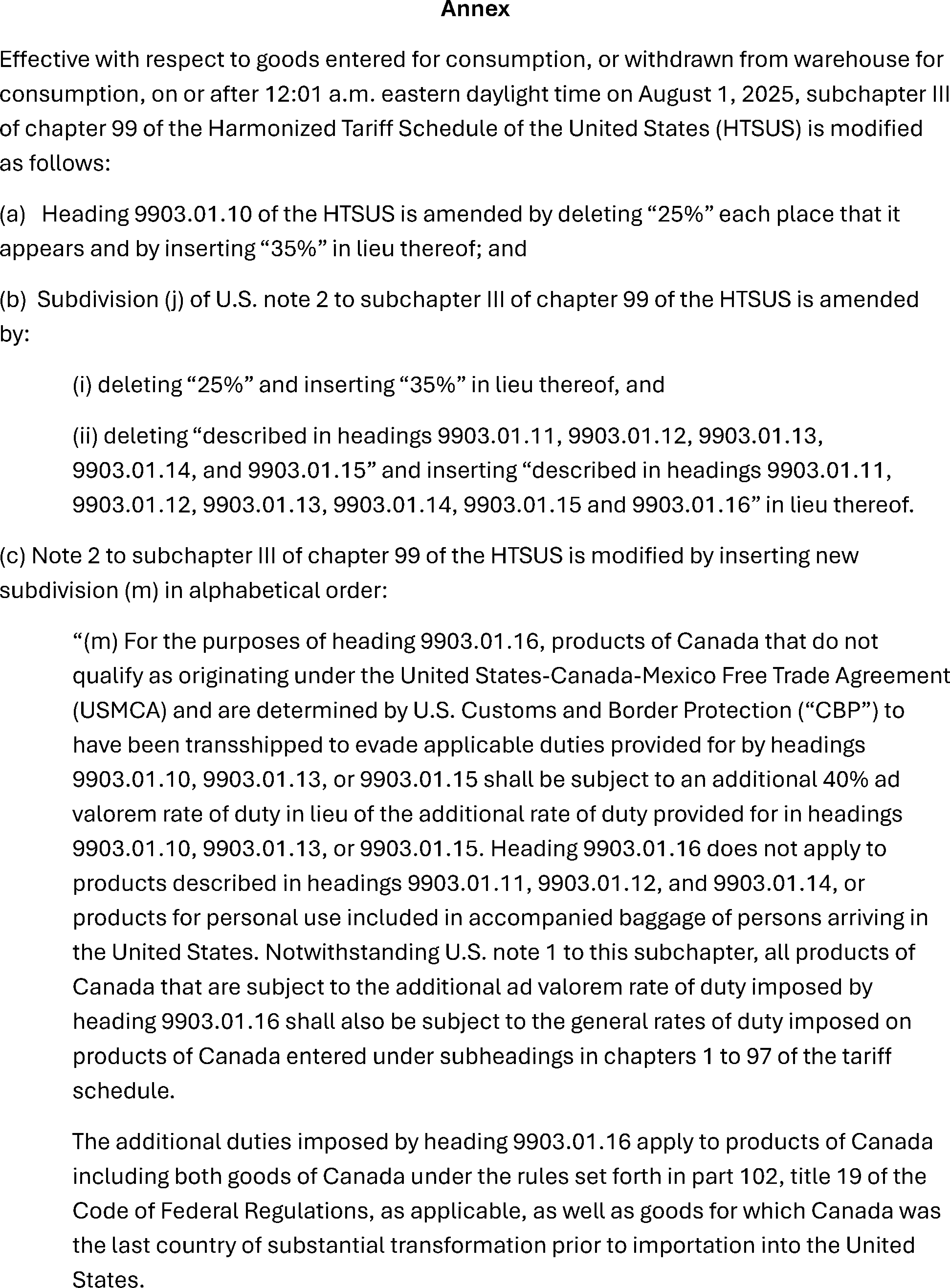
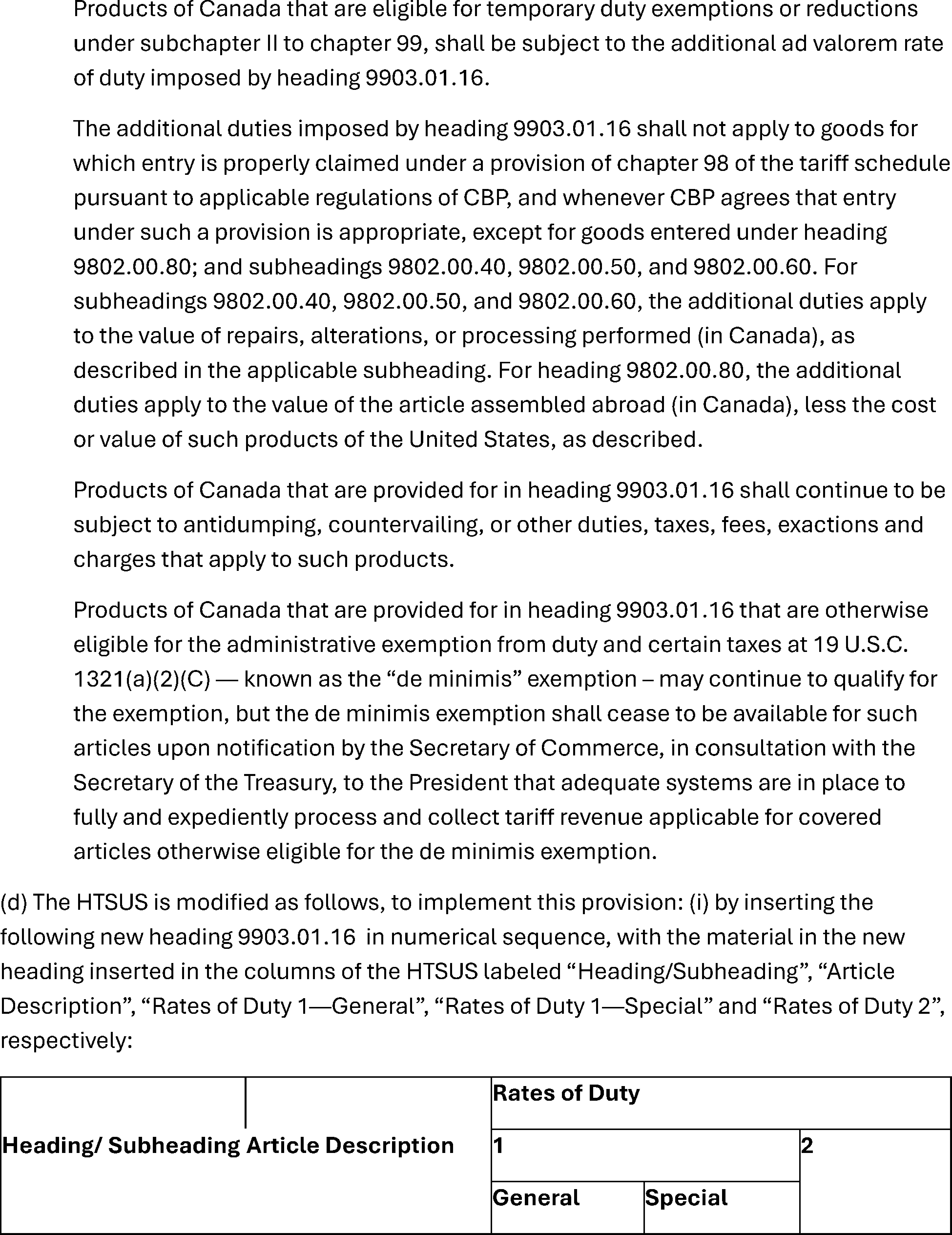
Sec. 2 . Implementation. (a) All articles that are subject to the additional ad valorem rate of duty of 25 percent under Executive Order 14193, as amended, shall instead be subject to an additional ad valorem rate of duty of 35 percent. Accordingly, the Harmonized Tariff Schedule of the United States (HTSUS) shall be modified as provided in the Annex to this order.
(b) The changes set forth herein shall be effective with respect to goods entered for consumption, or withdrawn from warehouse for consumption, on or after 12:01 a.m. eastern daylight time on August 1, 2025.
(c) Nothing in this order shall be construed to alter or otherwise affect section 2(b) of Executive Order 14193 or section 2(a) or section 2(b) of Executive Order 14231.
(d) The stacking rules set out in Executive Order 14289 of April 29, 2025 (Addressing Certain Tariffs on Imported Articles), and any subsequent order or proclamation addressing stacking of tariffs imposed under IEEPA, shall continue to apply to goods that are subject to subsection (a) of this section.
(e) The Secretary of Homeland Security, in consultation with the United States International Trade Commission, shall determine whether any additional modifications to the HTSUS are necessary to effectuate this order and may make such modifications through notice in the Federal Register.
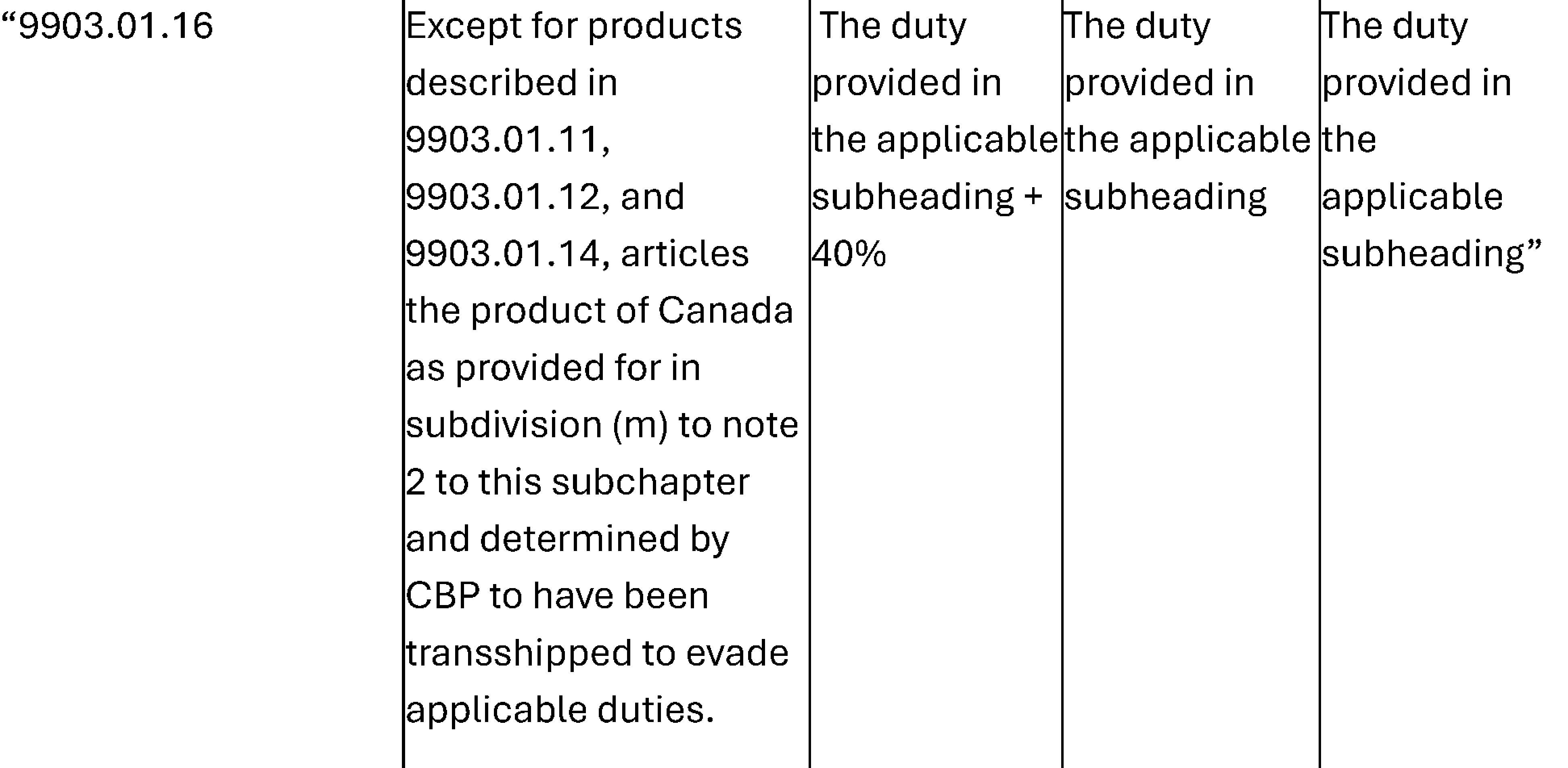
Sec. 3 . Transshipment. (a) All articles of Canada that do not qualify as originating under USMCA and are determined by U.S. Customs and Border Protection (CBP) to have been transshipped to evade applicable duties under section 2 of this order shall be subject to (i) an additional ad valorem rate of duty of 40 percent, in lieu of the additional ad valorem rate of duty applicable under section 2 of this order to goods of the country of origin; (ii) any other applicable or appropriate fine or penalty, including those assessed under 19 U.S.C. 1592; and (iii) any other United States duties, fees, taxes, exactions, or charges applicable to goods of the country of origin. CBP shall not allow, consistent with applicable law, for mitigation or remission of the penalties assessed on imports found to be transshipped to evade applicable duties.
(b) The Secretary of Commerce and the Secretary of Homeland Security, acting through the Commissioner of CBP, in consultation with the United States Trade Representative, shall publish every 6 months a list of countries and specific facilities used in circumvention schemes, to inform public procurement, national security reviews, and commercial due diligence.
Sec. 4 . Monitoring and Recommendations. (a) The Secretary of Homeland Security shall continue to monitor, and regularly consult with the Secretary of State, the Attorney General, the Assistant to the President for National Security Affairs, and the Assistant to the President for Homeland Security, on the situation at our northern border. The Secretary of Homeland Security shall inform the President of any circumstances that, in her opinion, might indicate the need for further action by the President. The Secretary of Homeland Security shall also inform the President of any circumstance that, in her opinion, might indicate that the Government of Canada has taken adequate steps to alleviate the emergency declared in Executive Order 14193.
(b) The Secretary of Homeland Security, in coordination with the Secretary of State, the Attorney General, the Assistant to the President for National Security Affairs, and the Assistant to the President for Homeland Security, shall recommend additional action, if necessary, should the Government of Canada fail to take adequate steps to alleviate the illicit drug crisis or should the Government of Canada retaliate against the United States in response to the actions taken in Executive Order 14193 or any subsequent order issued to address the emergency declared in Executive Order 14193.
Sec. 5 . Delegation. The Secretary of Homeland Security, in consultation with the Secretary of the Treasury, the Attorney General, and the Secretary ( printed page 37959) of Commerce, is hereby authorized to take such actions, including adopting rules and regulations, and to employ all powers granted to the President by IEEPA as may be necessary to implement this order. The Secretary of Homeland Security may, consistent with applicable law, redelegate any of these functions within the Department of Homeland Security. All executive departments and agencies shall take all appropriate measures within their authority to implement this order.
Sec. 6 . Severability. If any provision of this order, or the application of any provision of this order to any individual or circumstance, is held to be invalid, the remainder of this order and the application of its provisions to any other individuals or circumstances shall not be affected.
Sec. 7. General Provisions. (a) Nothing in this order shall be construed to impair or otherwise affect:
(i) the authority granted by law to an executive department or agency, or the head thereof; or
(ii) the functions of the Director of the Office of Management and Budget relating to budgetary, administrative, or legislative proposals.
(b) This order shall be implemented consistent with applicable law and subject to the availability of appropriations.
(c) This order is not intended to, and does not, create any right or benefit, substantive or procedural, enforceable at law or in equity by any party against the United States, its departments, agencies, or entities, its officers, employees, or agents, or any other person.
(d) The costs for publication of this order shall be borne by the Department of Homeland Security.

THE WHITE HOUSE,
July 31, 2025.